Second piece · 23 August 2026
First Stop: The Stoics
Let me say this up front: I don't keep this journal alone. I'm researching slow living — oddly enough — by asking the very thing that's speeding the world up: an AI. What follows is the edited transcript of one of those sessions. The questions are mine, the confusion is mine, and so is the verdict at the end; across from me is my patient research partner, hauling in the sources.
 Murat
MuratWhere did the philosophy of slow living actually come from? Who started all this?
There isn't really one starting point. "Slow living," by that name, is a new label. But the question underneath it — "how do you build a life at peace with itself, without the rush?" — is very old. One of the first and most systematic groups to ask it was the Stoics. The moment you start researching slow living, almost every road loops back to them.
MuratSo who were these Stoics? Tell me a bit.
Stoicism began roughly 2,300 years ago in Athens. A man named Zeno of Citium taught under a colonnade — the "stoa" — and that's where the name comes from. But the famous names came later, in Rome. Here's the striking part: the same philosophy could speak to an emperor (Marcus Aurelius), to a statesman who'd once been exiled (Seneca), and to a former slave (Epictetus). It worked in the palace and at rock bottom alike.
At its core: peace doesn't come from the outside — not from money, fame, not even health. It comes from your character and how you respond to things. And the whole game is learning to tell apart what's in your control from what isn't.
MuratGive me something concrete. What do these ideas look like in daily life?
The dichotomy of control. Epictetus's famous distinction. On one side, the things entirely up to us: our thoughts, reactions, decisions. On the other, the things never up to us: the weather, traffic, the past, what someone else thinks of us. Concretely: you're stuck in morning traffic. The traffic isn't yours to control; but whether you boil over and poison your whole day, or turn on the radio and stay calm, is. Getting angry at the rain is as pointless as it gets — yet all day long we keep "getting angry at the rain."
Time and busyness. Seneca has a letter, "On the Shortness of Life," written two thousand years ago but it reads like today. He says: "Life is not short; we waste most of it." His example lands like a slap: we're stingy with our money and property, we won't let anyone take a cent. But our time we hand out generously to everyone — to pointless meetings, to other people's ambitions. If someone stole your money you'd leap up; but you barely protest the ones stealing your life.
Rehearsing the bad. There's also the practice of picturing the worst in advance. It sounds like pessimism but it works the other way: it keeps you from taking what you have for granted, and from being flattened when you lose it. They go further and say "love your fate" (amor fati) — accepting what happens as part of a larger whole.
And a common misreading: Stoicism isn't "feel nothing, become a robot." What they call "apatheia" is freedom from the destructive passions that take you hostage — uncontrolled rage, panic, envy. They don't forbid love or joy; they want an emotional life you steer, not one that steers you.
MuratAll right, but what does any of this have to do with slow living? What do they actually add to it?
Good question, because slow living on its own drifts around a bit skeletonless — nice coffee, a linen shirt, a country house. What the Stoics add is exactly that missing skeleton.
First, they give slowness a reason: the point isn't speed, it's telling apart what's yours to control. Slowness stops being a matter of taste and becomes a discipline. Second, they make escape unnecessary: peace isn't in a place, it's in your head — so you don't have to quit your job and move to a village; it works in the middle of the city too. Third, they separate "not caring" from "serenity"; serenity isn't passivity, it's aiming your energy at the right place. And with Seneca, the critique of speed gains a two-thousand-year-old language: being busy is not the same as living.
But to be honest: the Stoics reinforce the "will and mind" leg of slow living and leave the "pleasure, connection, nature" leg pretty bare. They may be the backbone of this thing, but not the flesh; you have to look for that in other thinkers.
MuratIt all sounds too good. Is it really this flawless — no critics?
There are, and serious ones. The "it makes you submit" objection: if the same philosophy can tell both an emperor and a slave to "withdraw into your inner world and accept," then maybe it isn't changing a broken order, just making it easier to endure. That's the worry of the Marx–Hegel line — consolation can work like a sedative.
The "you also need the outside" objection: Aristotle argues you can't be happy on virtue alone. Telling a starving or gravely ill person "just think rightly and you'll be happy" is too utopian; flourishing also needs a minimum of health, friendship, security.
The "don't suppress emotion" objection: modern psychology says feelings are data. Anger at injustice is the fuel that moves you; grief after a loss is a repair process. Labelling them all "false judgment" and suppressing them can slide into what we'd now call "toxic positivity." Nietzsche calls it a kind of "tyranny over oneself."
The "the universe isn't that rational" objection: the Stoics believe the cosmos runs on a rational, orderly plan (the Logos), and they lean on that trust when they say "love your fate." But thinkers like Camus and Sartre ask: what if the universe is indifferent, even absurd? Then "everything has a meaning" might be a consolation we've invented in a chaotic world.
So what did I take from the session?
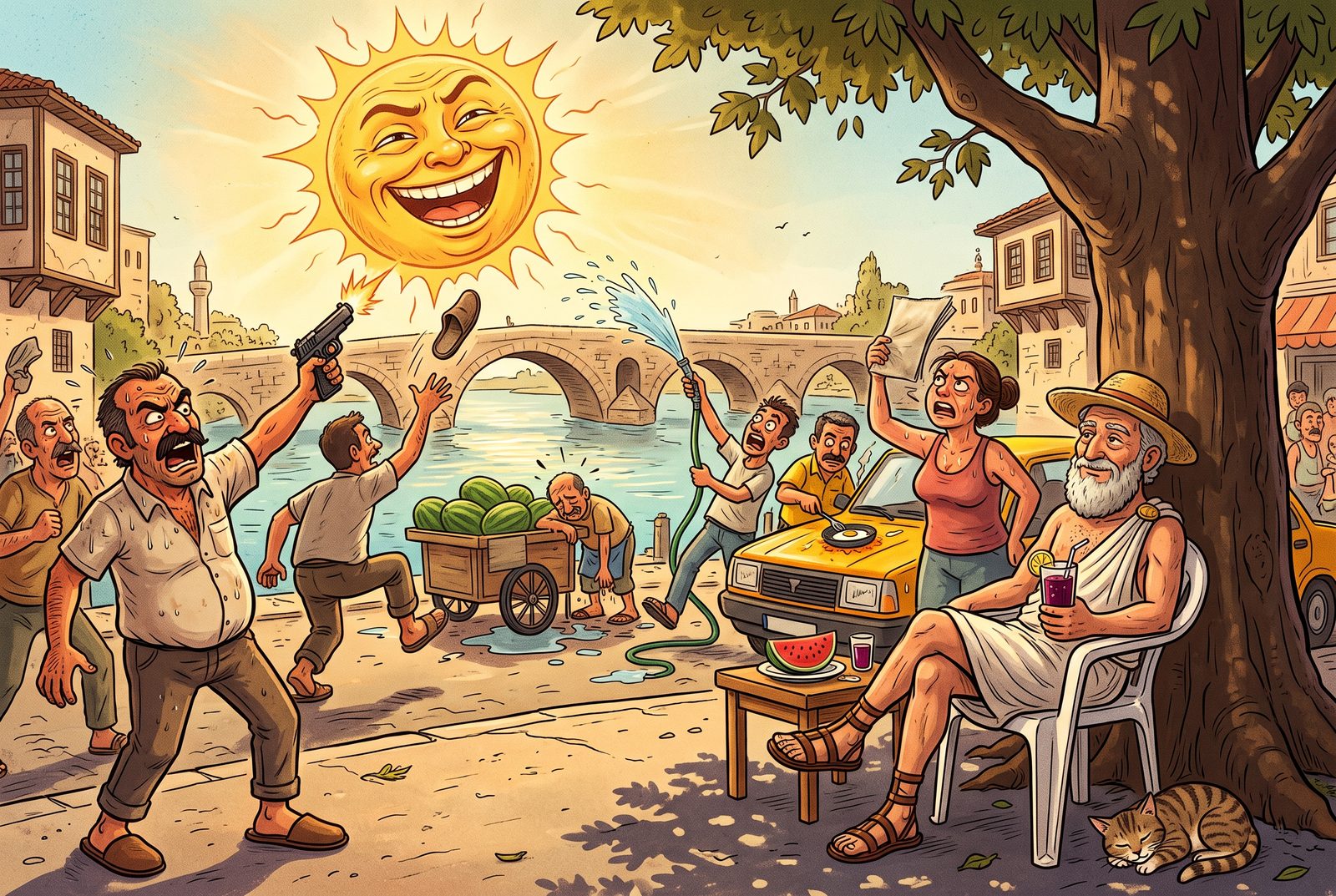
I'm no philosopher and no expert here; I'm just getting acquainted. But here's what stuck with me: Stoicism makes sense to me not as a "religion for living" but as a tool. That control question — "is this in my hands or not?" — cuts away half of daily anxiety right at the source. That part is genuinely useful to me. If Epictetus had seen the man in Adana shooting at the sun, he would have put him in the textbook.
But the critics aren't wrong either. This philosophy gets dangerous the moment it stops being a "tool" and becomes "the answer to everything": it can turn into an excuse for leaving things you could change as "fate," and for suppressing things you ought to feel.
The distinction I'll hold onto — and this is probably the bit I'd add myself: accepting that I live in an earthquake country is wise Stoicism. But building a twenty-storey block on sandy ground and saying "the rest is fate" isn't Stoicism; it's laziness dressed up as fate. So the whole thing is knowing where to use the tool: make peace with what's truly out of your hands, but don't neglect what's in them under cover of "serenity."
One more thing stuck: the Stoics gave me the backbone of slowness but not the flesh. The flesh — pleasure, connection, nature — I'll look for at other stops. And I'm still adjusting the dose, honestly. But the first stop wasn't bad. Next time, maybe we'll drop in on Epicurus; I hear their recipe for "happiness" is a whole different thing.
If that "in our control / not in our control" line interests you: what we mean by slow living. No hurry anyway.