First piece · 25 July 2026
Remembering How to Breathe in a World Doing a Billion Operations a Second
The other day I joined an AI training online. For two years now I've been part of Komünite — a community that plays an active role in the entrepreneurship ecosystem and runs regular AI trainings. Whenever a new session opens, I'm there. It's been three or four years since AI entered our lives, and from day one I've followed every development without missing a single one.
Let me confess: in the early days I turned my nose up at this technology. "It's a toy," I said. That toy, the other day, laid out in seconds the things I'd spent years learning.
As the screen's light hit my face, I slumped into the chair. Let me sum up in one word what I felt down to my bones: inadequacy.
Here's the funny part: I'm someone who makes a living from technology. The number of people following these developments as closely as I do is probably less than one in a thousand worldwide. Statistically I ought to feel like some kind of pioneer, right?
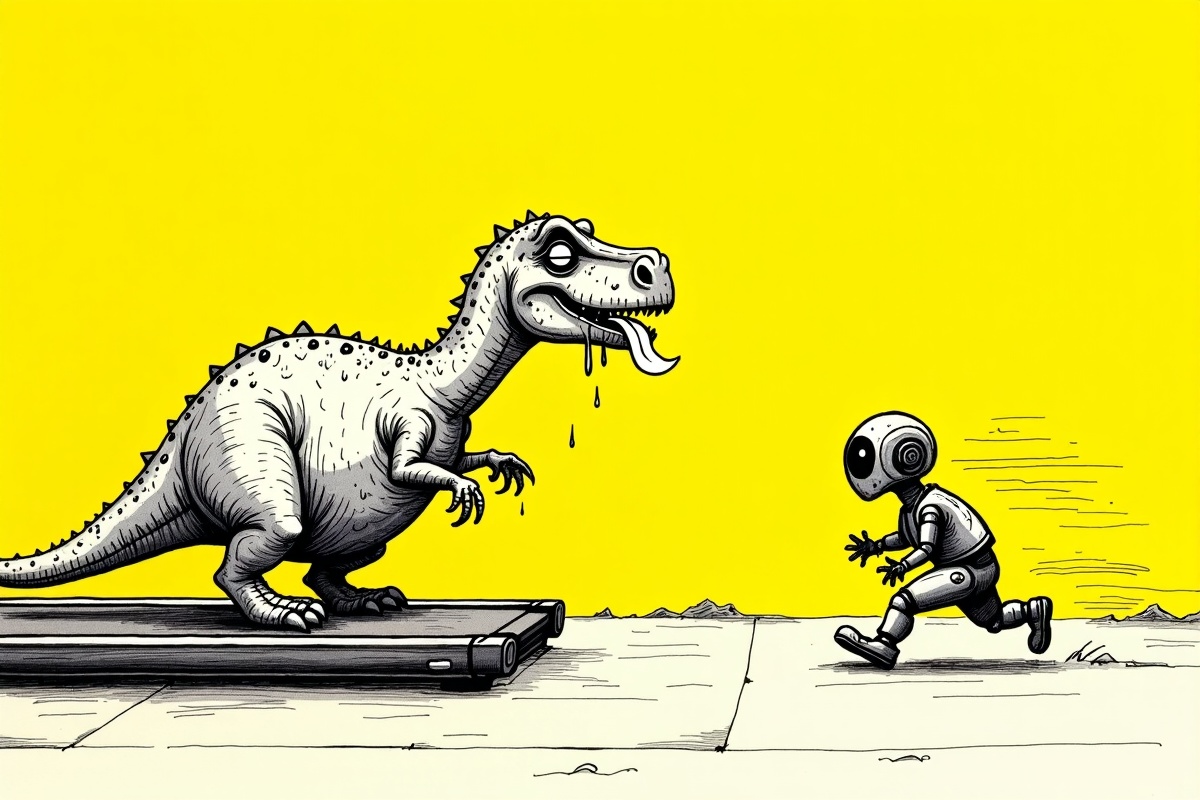
Quite the opposite. In the middle of that training I felt like a dinosaur, out of breath, in a footrace against fibre-optic cables. The machine updates with a new version every week; and because I can't keep up with that pace, I'm literally ashamed of my own biology. Can you imagine?
In that "throwing an error" moment, I understood once more why I've been thinking so hard about this business of slowing down.
Our biggest mistake is this: we try to sync our heartbeat to the processor's clock speed. But the human brain has no capacity to keep pace, at the same speed, with a technology that changes every fraction of a second. We're made of flesh, bone, and — unfortunately — a nervous system with limits.
The machine can speed up. That's its nature; let it. The problem isn't the machine's speed, but our mistaking that speed for a measure of success and imposing it on ourselves.
However fast you run on a treadmill, the place you arrive is always the same: right where you are.
Turns out I wasn't alone
Wandering the internet with this confusion, I realised the feeling wasn't just in my own head. It turned out that philosophers across the ages had wrestled with it too, leaving behind libraries' worth of writing over thousands of years. From Seneca to Plato, from Epicurus to the present-day thinker Hartmut Rosa, many people have studied the relationship between the speed of life and the speed of human existence, and had something to say about it.
This pulled me in completely. And I decided to look into this philosophy of living.
What does a software person do when they decide something? Naturally, the first thing I did was open a website about it: No Time to Hurry (notimetohurry.com). Its only member, for now, is me. Here, as I deliberately slow my own pace, I share what I run into and what I learn — both on this site and on LinkedIn.
I have no commercial aim. No hidden agenda. No grand claims.
I don't even mean to "leave a sweet echo under this eternal dome," honestly. I'm just filling this site like a field journal. Maybe something lovely will come of it later; and if it doesn't, no problem. I've got nowhere to be anyway.
If the ideas behind this piece catch your interest, take a look at what we mean by slow living. No hurry.